
Wednesday, February 10, 2016
LAD #31: Wilson's Fourteen Points
President Wilson wrote the Fourteen Points in hopes of establishing world peace. He thought that peace with Russia was an attainable short term goal, and that the reasons for which the Great War was fought were moral and justified. His fourteen points included: open and public treaties, freedom of the seas, removal of economic barriers and equal trade, reduction of weapons, impartial adjustment of colonial claims, an evacuation for Russia, sovereignty for Belgium, correction of the wrong-doings to France by the Prussians, readjustment of Italian borders, development of Austria-Hungary, evacuation of Rumania, Serbia and Montenegro, free passage for Turkish Romanians, creation of a sovereign Polish state, and an association of nations geared towards world peace and protection. The last point that Wilson noted evolved into the League of Nations, and was thought to be the most important by Wilson because he willingly compromised all of his other points for its creation. The Fourteen Points were an attempt to settle the war and prevent further conflicts, although later on this proved to be impossible.

LAD #30: Schenck vs. US
Schenck disliked the enlisting of soldiers under the Conscription Act, so he released a public message that stated that everyone should peacefully resist the Act placed during the Great War. He was charged with violating the Espionage Act for hindering recruitment. Holmes claimed that the First Amendment did not apply to the circumstance and could not protect Schenck's words. He explained that the US was at war, so they could not afford actions like Schenck's because they caused a "clear danger" to the nation. The government was afraid that people would listen to what Schenck said and therefore disobey the government. The case established the Congress as a restrictor of free speech during wartime when necessary.

Wednesday, January 20, 2016
LAD #29: Keating-Owen Child Labor Act
Congress passed the Keating-Owen Child Labor Act in 1916 after it was proposed by Senator Beveridge. The act controlled child labor in factories by using the federal government to regulate interstate commerce. The act also prevented the sale of products from any company that employed children under the age of 14, and any mine that employed children under the age of 16. Additionally, it banned the sale of products from any business that had children under the age of 16 working the night shift or more than 8 hours per day. Although it was approved by President Wilson, the Supreme Court declared it was unconstitutional due the the Hammer v. Dagenhart case. The public strongly supported child labor reform, but it still took a long time to implement. The Supreme Court didn't revoke its declaration regarding the case until 1941.

LAD #28: Wilson's First Inaugural
Woodrow Wilson, a Democrat, was elected as a result of the 1912 election, in which there was a split between the Republican Taft and Progressive Roosevelt. In Wilson's Inaugural Address, Wilson discussed the morals of the American people and the necessity for change in society. He mentioned the success of the Industrial Revolution, but also addressed the issues the revolution caused. The corruption present throughout the country had to be fought, human rights had to be established, and government had to stop being used for private purposed. He stressed the need for reform, and promised reforms like laws concerning sanitation, food, and the conditions of labor. Wilson hoped to restore the nation, and even though he stated the nation was in need of improvement, his speech was one full of hope and positivity.

LAD #27: Clayton Anti-Trust Act
The Clayton Anti-Trust Act was passed by Congress in 1914, following the failure of the Sherman Anti-Trust Act. The Clayton Act prevented companies from forming exclusive contracts, rebates, inter corporate stock holdings, and price cutting. While it was very similar to the Sherman Act, there was a slight difference; in the Clayton Act, labor unions were not considered to be constraints of the economy. The act was influential because it didn't try to prevent unions from forming or carrying out their plans for reform.


Friday, January 8, 2016
LAD #25: Dawes Severalty Act
The Dawes Act of 1887 served the purpose of replacing the lands that were previously possessed by Native Americans with individually owned properties. The act relocated Native Americans to reservations that were determined beforehand. The Natives were forced onto sections of land that could be observed at any given time. Each person was given a certain amount of land, and the head of the family was given a quarter of the land. If they weren't granted land on the reservation, they were permitted to live somewhere else in the US. The act was valid for 25 years, and then the President would have to decide whether to continue or end the act. It also gave all Native Americans the benefits of being under American law and equal rights as Americans. The government had the power to use the land for whatever they wanted for 5 years, and then after that point, the Natives were able to keep the land forever.

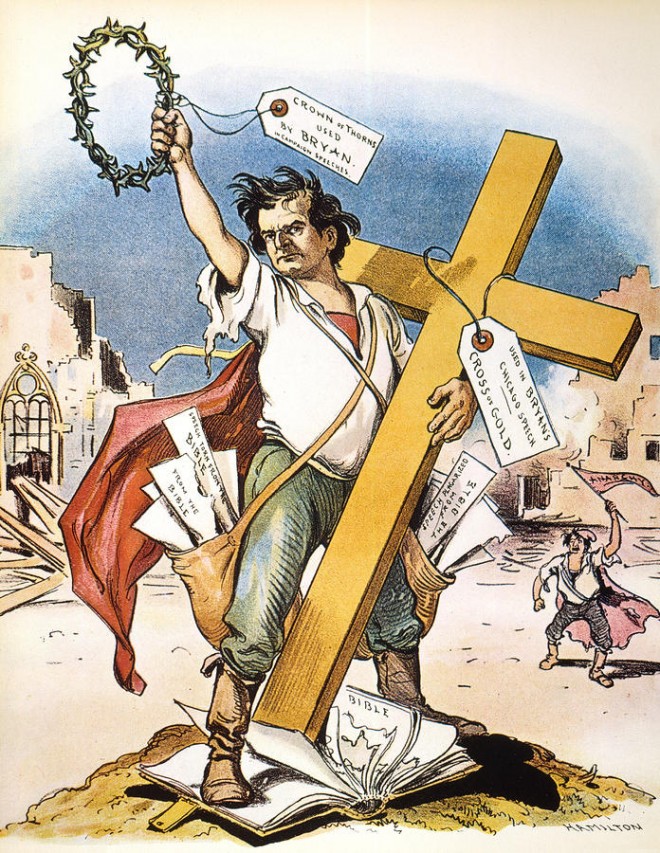
LAD #24: Cross of Gold Speech
William Jennings Bryan delivered a speech in 1896 about his opinion of silver currency being in a 16 t0 1 ratio with gold in the American economy. Implementing this policy would help farmers in debt because the inflation would increase the amount of money in circulation. Bryan believed that doing so was the humane and right thing to do for the country. He had no interest in fighting, but he did want to clear the waters. He argued that America was a country established to represent the people, and believed that he was representing the majority of the people when he supported coinage of silver. He also advocated for an income tax, saying that the country was in need of a leader to distribute the wealth to the people. He conceded by saying that many people from cities supported the gold standard, but he let them know that their wealth came from the poor, and the poor needed the coinage of silver.
Subscribe to:
Posts (Atom)